Leave Your Message
0%

Choosing a reliable bamboo chopping block manufacturer in China isn’t just about comparing pretty catalog photos. There’s a lot more to consider—things like the factory’s experience, how they control the materials, machining precision, and whether the product is safe for food contact. A smooth-looking surface might seem impressive at first, but if it’s not dried properly, the board could warp, crack, or develop unpleasant smells after a few rounds in the dishwasher. Ain’t nobody got time for that, right?

In this guide, I’m going to introduce you to ten of the top Chinese manufacturers and show you what makes each of them stand out. We’ll talk about how they source their bamboo, the carbonization process, what kind of adhesives they use, their pressing tech, edge finishing, and how strict their quality checks are. Plus, we'll look at private-label options, packaging choices, how much they can produce, and their experience with exports. All these details are super helpful whether you're an importer, retailer, or a brand trying to get your kitchenware just right.

But honestly, what really counts is how their products perform in the real world.

A good bamboo chopping block should feel solid on your kitchen counter—no wobbling or loose joints. It should hold up to regular use without getting deep knife marks that ruin its look. We also check how well it manages moisture, stays uniformly thick, and whether the manufacturer provides clear documentation. If possible, I recommend looking at factory audits, test reports, customer reviews, and detailed manufacturing records—these say a lot more than just some glossy marketing pitch.

Keep in mind, this ranking isn’t set in stone. Things can change—like updates in equipment, staffing, or order volume. Some factories are great at communicating but maybe don’t offer much customization. Others might make awesome boards but lack sturdy packaging. Those little details can make a difference and are easy to overlook. So, before you place a big order, it’s wise to ask for samples, double-check inspection standards, lead times, and that all your compliance boxes are checked. This overview should give you a solid starting point, but a little extra diligence never hurts.

China Top 10 Bamboo Chopping Block Manufacturers?

What Is a Bamboo Chopping Block?

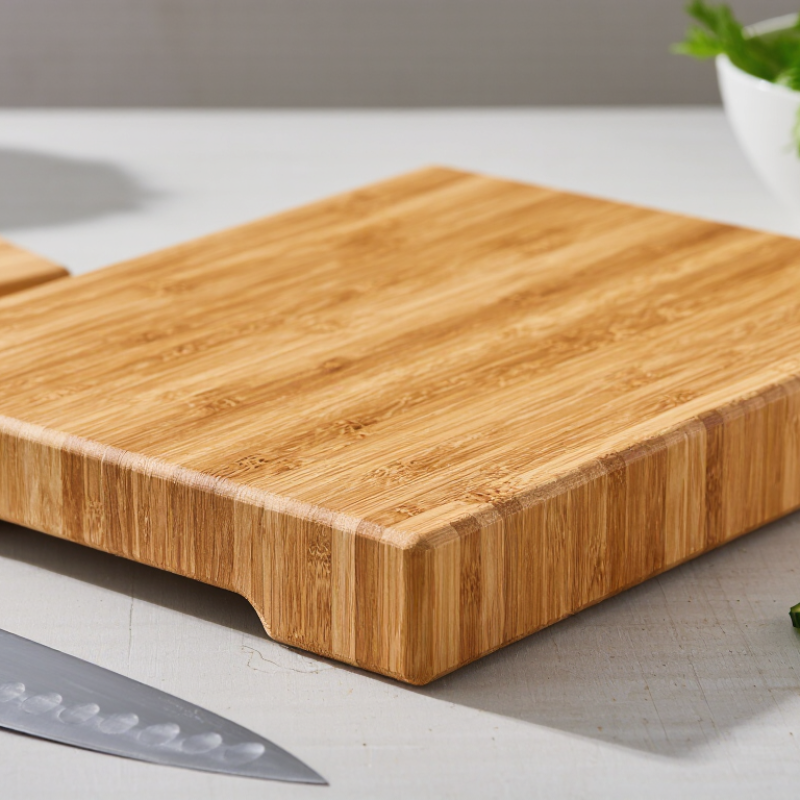
A bamboo chopping block is a kitchen cutting surface made from laminated strips of bamboo. Unlike solid timber, bamboo is a fast-growing grass, not a traditional tree. Manufacturers usually split, dry, steam-treat, and press the strips with food-contact adhesive. The result is a dense, stable board with a warm, natural appearance. Its tight surface handles vegetables, herbs, and boneless meats well. It is not indestructible. Deep knife marks can hold moisture and odors, especially when the board stays wet. Quality depends on bamboo maturity, drying control, adhesive safety, and accurate pressing. These details matter more than attractive grain alone.

Tips: Check for smooth edges, even lamination, and a level cutting face. Choose a practical thickness; thin boards may warp, while heavy blocks can be difficult to move. Use one board for produce and another for raw meat when possible. Wash by hand, then dry both sides immediately. Apply suitable food-grade mineral oil occasionally. Do not soak bamboo or place it in a dishwasher. Small habits protect the surface. Inspect the board after several months. I would replace it when cracks become difficult to clean.

For buyers comparing bamboo chopping block manufacturers, ask for material composition, adhesive documentation, moisture testing, and care instructions. Reliable producers should explain whether the board uses edge-grain or face-grain construction. Construction affects durability, knife feel, and resistance to splitting. A board may look premium but still perform poorly if bonding is uneven. That is an easy detail to miss. In my experience, moderate thickness and careful maintenance often outperform exaggerated claims about hardness. Bamboo can dull knives faster than softer wood, although cutting comfort varies by design and finish. Some users prefer its firm feel; others find it too unforgiving.

Why Bamboo Is Used for Chopping Blocks

China Top 10 Bamboo Chopping Block Manufacturers: Why Bamboo Is Used for Chopping Blocks

Bamboo chopping blocks are popular because the material is strong, renewable, and practical. Bamboo grows quickly and can produce dense, stable fibers. Its surface feels firm under a knife, yet it is gentler than glass or stone. This balance helps reduce unnecessary blade damage during daily food preparation. Bamboo also has a naturally warm appearance, with fine lines that make kitchen work feel less industrial. In quality manufacturing, laminated strips are pressed tightly and finished smoothly. This construction can limit cracking, although no bamboo block is completely immune to moisture or pressure.

Tips: Wash the block by hand and dry it immediately. Do not soak it overnight. Apply food-safe mineral oil when the surface looks pale or rough. Keep raw meat and vegetables separate, even when the block appears clean. Replace the block if deep grooves, splitting, or persistent odors develop.

Material quality still matters more than appearance. Experienced manufacturers should control moisture content, bonding strength, sanding, and finishing safety. A heavy block is not automatically better. Excessive hardness may feel stable but can dull knives faster. I have found that many buyers focus on beautiful grain and overlook the underside. Small rubber feet can improve stability, but they may trap water after washing. That detail is easy to miss. Bamboo is practical, not perfect. Its environmental value also depends on responsible harvesting, durable construction, and long service life. Consumers should check care instructions and production information before choosing a chopping block.

Why Bamboo Is Used for Chopping Blocks

Bamboo chopping blocks are typically made from laminated bamboo strips. Their representative Janka hardness range is comparable to common chopping-block hardwoods, providing good durability while remaining suitable for repeated kitchen use. Actual hardness varies by bamboo species, manufacturing process, grain orientation, and moisture content.

Data shown in pounds-force (lbf). Bamboo is presented as a typical range; hardwood values are representative published Janka hardness values. References: USDA Forest Products Laboratory, Wood Handbook; ASTM D1037-based material testing data.

How to Evaluate Chinese Bamboo Chopping Block Manufacturers

When evaluating Chinese bamboo chopping block manufacturers, begin with the factory, not the catalog. Request a video tour or arrange an independent audit. Look for covered storage, clean cutting areas, and traceable bamboo sources. Experienced manufacturers can explain harvesting age, drying temperatures, and adhesive controls without vague answers. Ask whether bamboo is laminated horizontally or vertically. This detail affects hardness, warping, and knife feel. A thick bamboo chopping block should also have stable moisture content, not only an attractive edge.

Request samples from different production batches. Measure length, width, thickness, flatness, and weight after delivery. Place the block on a level counter; rocking suggests weak pressing or uneven sanding. Inspect glue lines under bright light. They should appear tight, with no open gaps or strong chemical odor. Ask for food-contact test reports from qualified laboratories, plus records for moisture, formaldehyde emissions, and coating composition. Documents need matching product codes and dates. A certificate with no traceable sample proves little.

Production capacity matters, but consistency matters more. Compare the approved sample with a later shipment, including corner radius, juice groove depth, packaging, and carton strength. Ask how defects are recorded and corrected. A reliable supplier provides inspection standards, replacement procedures, and realistic lead times. Communication is evidence too. Replies should answer measurements, tolerances, and testing methods directly. I have sometimes trusted polished photos too quickly; that was a mistake. One unanswered question may deserve more attention than a low quotation. Pricing should be reviewed alongside yield loss, inspection costs, shipping protection, and expected service life.

China Top 10 Bamboo Chopping Block Manufacturers? - How to Evaluate Chinese Bamboo Chopping Block Manufacturers

A practical supplier-evaluation framework based on product safety, manufacturing capability, quality control, customization, and export-readiness. Company names and brand-specific data are intentionally excluded.

No. Evaluation Dimension What a Qualified Manufacturer Should Demonstrate Evidence to Request During Supplier Verification Recommended Assessment Method
01 Material Origin and Traceability Uses mature, properly dried bamboo with documented sourcing and batch traceability. The material should be free from visible mold, insect damage, excessive cracking, and abnormal odor. Material specifications Supplier declarations Batch records Factory photographs Confirm the bamboo species, processing location, moisture-control process, and traceability from raw material to finished chopping block.
02 Food-Contact Safety Finished products should be suitable for food contact and manufactured with adhesives, coatings, and processing chemicals appropriate for the intended market. Food-contact test reports Adhesive declaration Coating information Laboratory records Ask for recent third-party testing relevant to the destination market, including heavy metals, formaldehyde, migration, and other applicable chemical limits.
03 Moisture and Drying Control Maintains controlled drying and storage conditions to reduce warping, splitting, microbial growth, and dimensional instability during transport and use. Kiln or drying records Moisture inspection logs Warehouse procedures Check moisture measurements from multiple production batches and compare pre-shipment results with an independent inspection.
04 Construction and Glue-Line Quality Strips or blocks should be securely bonded, evenly aligned, and free from open joints, delamination, excessive glue marks, and internal voids. Bonding specifications Pressing parameters Inspection checklist Defect samples Examine edge alignment, glue-line consistency, bonding strength, and resistance to separation after controlled moisture exposure.
05 Dimensional Accuracy Provides consistent length, width, thickness, corner radius, and flatness according to approved technical drawings or product specifications. Technical drawings Tolerance standards Calibration records Inspection reports Approve a golden sample and define measurable tolerances for dimensions, flatness, beveling, handles, grooves, and juice channels.
06 Surface Finishing and Usability Surfaces should be smooth, splinter-free, easy to clean, and appropriate for repeated food preparation. Edges should be safely rounded or beveled. Surface-finish samples Abrasive process details Edge-profile drawings Run a hand-feel inspection under strong light and check for splinters, sharp corners, sanding marks, stains, and uneven finishing.
07 Quality Management System Uses documented incoming, in-process, and final inspections with corrective-action procedures and clear responsibility for nonconforming products. Quality manual Inspection forms Corrective-action records Calibration certificates Evaluate whether quality controls are actually used on the production line rather than relying only on certificates or promotional claims.
08 Production Capacity and Lead Time Has sufficient equipment, labor, storage space, and production planning to meet the required volume without compromising inspection standards. Capacity statement Production schedule Equipment list Lead-time quotation Compare stated capacity with actual production records, peak-season planning, sample turnaround, and the supplier’s ability to maintain consistent quality at scale.
09 Customization and Packaging Capability Can support customized dimensions, surface treatments, grooves, handles, packaging, carton markings, barcodes, and instruction inserts when required. Prototype samples Packaging mock-ups Artwork approval process Drop-test records Request a pre-production sample and verify that the approved artwork, packaging dimensions, protective materials, and product specifications are reproduced accurately.
10 Export Compliance and After-Sales Support Provides accurate shipping documents, export packaging, product traceability, complaint handling, replacement procedures, and timely communication. Commercial documents Packing list format Complaint procedure Reference shipments Assess response speed, document accuracy, sample-to-order consistency, pre-shipment inspection support, and the written process for handling defects or shortages.
Buyer Recommendation: Do not select a manufacturer based only on price, product photographs, or certificates. Compare approved samples, documented specifications, independent test results, factory-process evidence, and pre-shipment inspection findings before placing a production order.

China’s Top 10 Bamboo Chopping Block Manufacturers

China’s Top 10 Bamboo Chopping Block Manufacturers are commonly evaluated by material quality, machining accuracy, and production consistency.

This ranking focuses on factories with export experience, documented quality procedures, and stable bamboo sourcing. A reliable manufacturer should explain its bamboo species, adhesive grade, moisture control, and finishing process clearly.

A professional Chopping Block factory checks each panel for cracks, loose joints, and uneven surfaces. Look for smooth edges, tight lamination, and a flat working face.

Some manufacturers offer end-grain or edge-grain construction, while others produce lighter laminated boards for everyday kitchens. Samples should be tested after washing and drying.

Small warping may appear later, even when the first inspection looks excellent.

Factory audits should include packaging, labeling, and batch records. Photos help, but they are not enough. Ask for recent inspection reports and production samples from different batches.

I would also confirm how rejected boards are handled. A low price can hide inconsistent moisture levels or rushed finishing.

That warning matters. The strongest suppliers usually communicate tolerances, lead times, and customization limits before receiving an order. Yet no factory is perfect; buyers should record defects honestly and review supplier performance over time.

Key Products and Manufacturing Strengths of Each Manufacturer

China’s top ten bamboo chopping block manufacturers show different strengths in products, materials, and production control. One focuses on thick end-grain bamboo blocks for professional kitchens. Another produces lightweight laminated boards for household retailers. A third combines bamboo with food-safe wood, creating stable Wooden Chopping Block designs with contrasting patterns. Its pressing process deserves careful inspection.

Several factories specialize in OEM kitchenware, offering custom sizes, juice grooves, handles, and laser engraving. Others maintain strong export capacity, with standardized sanding, moisture checks, and protective packaging. One manufacturer serves hospitality buyers with oversized butcher blocks. Another supports smaller orders and faster sampling. This flexibility helps new importers test demand without excessive inventory.

The strongest facilities usually control bamboo selection, carbonization, cutting, pressing, and finishing in one production system. Their key products include chopping blocks, bread boards, serving trays, and utensil organizers. Some use multi-layer construction to reduce cracking during seasonal changes. Others rely on dense, thick panels for better impact resistance. Factory audits should verify adhesive safety, edge finishing, moisture control, and batch consistency. Catalog photos can hide uneven surfaces. I would still request samples before judging workmanship. A beautiful board may warp after repeated washing. Reliable manufacturers explain care instructions clearly and provide test records when available.

How to Choose the Right Chinese Manufacturer for Your Needs

Choosing a Chinese bamboo chopping block manufacturer requires more than comparing factory prices. Start by checking material sourcing, drying, lamination, machining, and packing processes. Ask for the bamboo species, moisture range, adhesive type, and monthly capacity. Request recent food-contact safety reports, then verify the laboratory and testing scope yourself.

A factory audit can reveal details photographs hide: uneven joints, rough corners, dust near cutting areas, or cartons against damp walls. Look closely. Order samples in several sizes, including an Acacia Chopping Block if your range combines bamboo and hardwood. Test odor, warping, surface smoothness, drainage, and edge durability after washing. Ask how rejected pieces are handled. Their answer may reveal more than a brochure. Also review how the factory manages batch records and corrective actions.

Reliable manufacturers provide clear tolerances, inspection records, traceable batches, and realistic lead times. Confirm packaging strength with a drop test, especially for heavy blocks. Written specifications should cover dimensions, finish, logo placement, carton marks, payment stages, and defect remedies. Communication matters too; vague replies can become expensive later. Do not choose the lowest quote automatically. No checklist is perfect. Your market, shipment route, and quality threshold still require careful judgment.

Wholesale Guide to China Bamboo Docking Stations for Men’s Desktops and Phone Organization

China’s bamboo docking stations offer wholesalers a practical way to serve the growing demand for organized men’s desktop and phone-storage accessories. Designed for smartphones, watches, keys, and other daily essentials, this handcrafted organizer combines an integrated charging stand with a convenient catch-all tray. Bamboo provides a warm, natural appearance while offering a sturdy base for everyday use, and the sustainable varnish finish helps protect the surface from moisture, scratches, and wear. Skilled Chinese artisans can produce these units with consistent workmanship, making them suitable for retail collections, corporate gifting, and lifestyle accessory catalogs.

Demand for functional charging and organization products is supported by the continued expansion of connected-device ownership. According to the International Data Corporation’s Worldwide Quarterly Mobile Phone Tracker, global smartphone shipments remain in the billion-unit range annually, creating a large installed base of devices that require convenient charging solutions. At the same time, the United Nations Institute for Training and Research reported in the Global E-waste Monitor 2024 that the world generated 62 million tonnes of electronic waste in 2022, highlighting the value of longer-lasting accessories and responsible material choices. Wholesale buyers can source directly from a Chinese factory to access competitive pricing, customizable order quantities, and dependable supply while offering customers a refined, space-saving desktop solution.

FAQS

What is a bamboo chopping block?

It is a cutting surface made from pressed bamboo strips. Bamboo is a fast-growing grass, not a tree. The strips are dried, bonded, and compressed. The finished block feels dense and warm.

Why do people choose bamboo chopping blocks?

Bamboo offers a firm cutting surface and a natural appearance. It feels softer than glass or stone. It can handle vegetables, herbs, and boneless meat. Its renewable nature also attracts many buyers.

Can bamboo chopping blocks damage kitchen knives?

Bamboo may dull knives faster than softer wood. Its firm surface feels stable but less forgiving. Knife comfort depends on construction and finishing. User preference still matters.

How should a bamboo chopping block be cleaned?

Wash it by hand with mild soap and water. Dry both sides immediately with a clean towel. Never soak it overnight. Do not use a dishwasher.

How can I maintain the block’s surface?

Apply suitable food-grade mineral oil when the surface looks pale or rough. Check the underside, too. Rubber feet may trap water underneath. Small habits help.

When should a bamboo chopping block be replaced?

Replace it when deep grooves, cracks, splitting, or lasting odors appear. These areas can hold moisture and food residue. A few shallow marks are usually manageable. Difficult cleaning signals a problem.

What should buyers ask a manufacturer before ordering?

Ask about bamboo species, moisture levels, adhesive type, and construction style. Request food-contact safety documents and testing details. Confirm dimensions, tolerances, packaging, and lead times. Vague answers deserve caution.

How can a buyer check manufacturing quality?

Order samples in different sizes and inspect the edges closely. Look for even joints, smooth sanding, and a level face. Test odor, warping, drainage, and washing durability. Factory photographs can hide problems.

Is a thicker bamboo block always better?

No. A thin block may warp, while a heavy block can be awkward to move. Moderate thickness often offers a practical balance. I may still choose differently for frequent commercial use.

Conclusion

This guide explores what a Bamboo Chopping Block is and why bamboo has become a popular material for modern kitchens. It explains the advantages of bamboo, including its natural durability, attractive appearance, renewable character, and suitability for daily food preparation. Readers will also learn how to evaluate Chinese manufacturers by examining material quality, production standards, craftsmanship, customization options, quality control, packaging, order capacity, and export experience.

The article presents a practical overview of China’s top 10 Bamboo Chopping Block manufacturers without focusing on brand names. It compares their key products and manufacturing strengths, such as end-grain construction, laminated designs, different sizes and thicknesses, engraved surfaces, and tailored solutions for retailers or food-service businesses. Finally, it offers guidance on selecting the right supplier according to budget, product specifications, minimum order requirements, delivery expectations, sustainability goals, and communication quality, helping buyers make a confident and well-informed sourcing decision.

Lila

Lila

Lila is a dedicated marketing professional at a leading manufacturer that specializes in bamboo and wood houseware products. With a wealth of experience in the industry, Lila possesses a profound understanding of the intricate details of the company’s offerings and core business. Her expertise......
Previous China Top 10 Bamboo Cutlery Tray Manufacturers