Leave Your Message
Picking reliable Cooking Utensils suppliers isn’t just about comparing catalog prices. If you’re buying globally, you’ve got to look at material quality, production experience, inspection systems, and export track record. And honestly? A polished website doesn’t prove much.
This guide walks through ten established suppliers that serve international markets. For each one, we look at the stuff buyers actually care about: stainless steel grades, silicone temperature ratings, handle strength, packaging quality, minimum order quantities, and production capacity. Samples matter, too. A spatula can look great online, but then bend during repeated cooking tests. A saucepan accessory might show up with flimsy packaging or labels that leave you guessing.
Compliance deserves just as much attention. Ask for the relevant food-contact documents, factory audit records, test reports, and any declarations your target market requires. Good suppliers are clear about lead times, customization, replacement policies, and quality control. They should also be able to explain whether testing covers coatings, plastics, adhesives, and metal surfaces.
No supplier is perfect. Some are flexible with customization but want larger orders. Others have strong quality control but charge more. This guide recognizes those trade-offs instead of pretending there’s one simple winner. The evaluation pulls together supplier information, manufacturing indicators, buyer considerations, and what you can observe in the product itself. Still, things change. Production teams, certifications, and delivery performance should be checked before you sign a contract.
For importers, retailers, hospitality groups, and private-label brands, the right supplier can mean fewer returns and stronger customer trust. So compare carefully. Reliability comes from evidence—not promises.
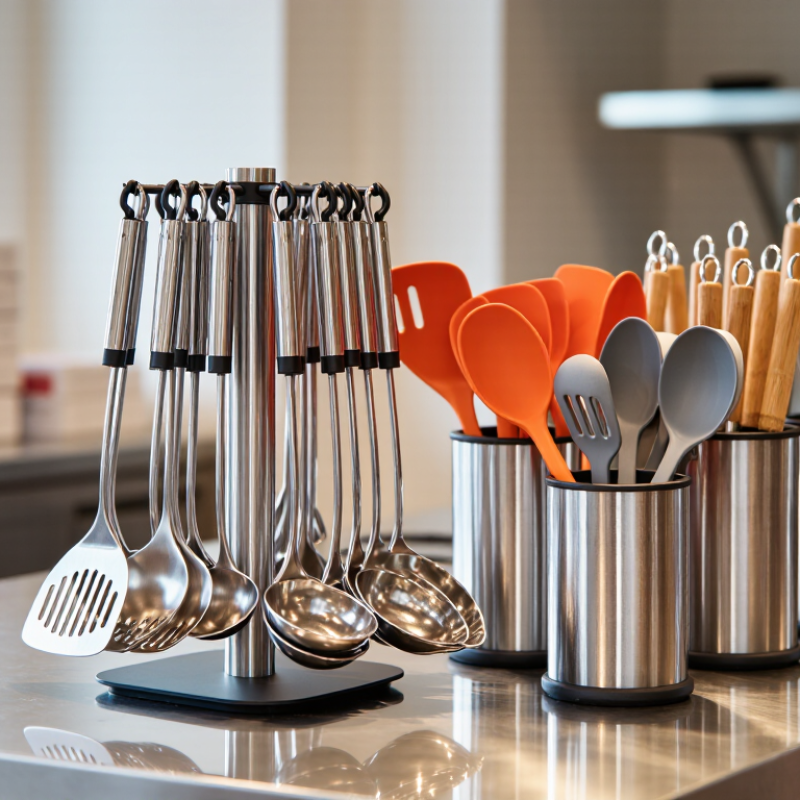
China’s cooking utensils manufacturing landscape is broad, specialized, and highly export-oriented. Factories commonly produce stainless steel ladles, aluminum pans, silicone tools, wooden accessories, and mixed-material sets. Many suppliers serve overseas buyers through OEM and private-label production, while others focus on standard catalog items.
Manufacturing often combines automated stamping with skilled hand finishing. A stainless steel turner may pass through cutting, forming, polishing, washing, and inspection. Silicone spatulas require controlled molding temperatures and careful checks for odor, flexibility, and surface defects. Buyers should request material specifications, food-contact test reports, coating details, and production samples before placing large orders. Factory audits can also reveal storage conditions, worker training, and calibration records.
Quality is not always consistent between samples and mass production. This is an uncomfortable point. A polished sample can hide weak process control. Experienced buyers compare several batches, inspect packaging, and test handles, welds, rivets, and edges. Clear drawings reduce misunderstandings. So does a written tolerance range. Some manufacturers offer strong engineering support, but smaller workshops may depend heavily on manual inspection. That can improve flexibility, yet it may also increase variation. Delivery planning should include mold development, pilot production, testing, and seasonal factory schedules. Local sourcing networks for metal, plastics, packaging, and finishing services can shorten lead times, although coordination becomes more demanding.
| Rank | Anonymized Supplier Segment | Main Product Categories | Common Materials | Core Manufacturing Processes | Typical Customization Options | Common Quality Documents | Best-Fit Buyer Applications | Key Buyer Considerations |
|---|---|---|---|---|---|---|---|---|
| 1 | Stainless-Steel Utensil Specialists | Turners, ladles, serving spoons, skimmers, tongs | Food-contact stainless steel, commonly grades 304 and 430 | Stamping, deep drawing, wire forming, spot welding, polishing | Handle shape, thickness, surface finish, hanging hole, retail packaging | Material test reports, food-contact declarations, dimensional inspection reports | Household retailers, restaurant-supply distributors, private-label programs | Check steel grade, weld strength, edge smoothness, and corrosion resistance |
| 2 | Silicone Kitchen-Tool Manufacturers | Spatulas, brushes, whisks, scrapers, spoonulas | Food-grade silicone with stainless-steel, nylon, or glass-fiber-reinforced cores | Silicone molding, insert molding, compression molding, assembly | Color matching, logo placement, hardness, handle design, multi-piece sets | Food-contact test reports, migration testing, temperature-use specifications | Consumer kitchenware, baking collections, promotional gift sets | Confirm silicone composition, odor performance, heat-use limits, and core stability |
| 3 | Nylon and Heat-Resistant Tool Producers | Turners, spoons, pasta servers, masher heads, utensil sets | Food-contact nylon, polypropylene, thermoplastic elastomers | Injection molding, two-shot molding, ultrasonic welding, assembly | Color, texture, handle geometry, hanging features, packaging format | Polymer identification, food-contact compliance documents, production inspection records | Non-stick cookware accessory programs and value-oriented retail lines | Evaluate heat deflection, dishwasher performance, odor retention, and scratch resistance |
| 4 | Bamboo and Wood Utensil Workshops | Cooking spoons, spatulas, salad servers, rolling pins, utensil sets | Bamboo, beech, rubberwood, acacia, and other approved hardwoods | Cutting, turning, CNC shaping, sanding, oiling, laser engraving | Wood species, shape, engraving, surface treatment, gift-box packaging | Wood-origin documentation, finish specifications, moisture and visual inspection records | Eco-positioned retailers, hospitality suppliers, gift and home-living channels | Verify species, moisture control, splinter prevention, finish safety, and traceability |
| 5 | Cast-Iron and Carbon-Steel Cookware Tool Makers | Skillets, griddles, grill presses, trivets, pan accessories | Cast iron, carbon steel, stainless steel components | Sand casting, die casting, machining, shot blasting, seasoning or coating | Shape, capacity, handle design, surface treatment, carton configuration | Chemical composition reports, coating or seasoning specifications, load testing | Outdoor cooking, restaurant equipment, traditional cookware collections | Inspect flatness, wall thickness, coating consistency, handle security, and packaging protection |
| 6 | Aluminum Cookware and Utensil Factories | Frying pans, saucepans, baking trays, measuring tools, turners | Aluminum alloys, stainless-steel bases, non-stick coating systems | Stamping, extrusion, die casting, CNC machining, spray coating | Diameter, wall thickness, handle system, coating color, induction base, packaging | Alloy reports, coating test results, thermal and dimensional inspection reports | High-volume cookware programs, foodservice, supermarket ranges | Confirm compatibility with gas, electric, ceramic, and induction cooktops |
| 7 | Copper and Premium Metalware Producers | Copper pans, sauté tools, decorative serving utensils, specialty cookware | Copper, stainless steel, brass accents, tin or stainless-steel linings | Spinning, forming, brazing, riveting, polishing, lining application | Metal thickness, lining type, handle material, finish, engraved details | Metal composition reports, lining specifications, workmanship inspection records | Premium kitchenware, culinary schools, specialty retail, hospitality projects | Review lining integrity, handle fastening, polish quality, and care instructions |
| 8 | Measuring and Portion-Control Tool Suppliers | Measuring cups, measuring spoons, scales, timers, portion scoops | Stainless steel, polypropylene, ABS, glass, electronic components | Injection molding, stamping, laser marking, assembly, calibration | Measurement units, scale readability, color, engraving, display language, packaging | Calibration records, accuracy reports, material declarations, battery documentation where applicable | Baking brands, commercial kitchens, food manufacturers, educational programs | Specify measurement standards, tolerance, readability, calibration frequency, and labeling |
| 9 | Kitchen Tongs, Whisks, and Wire-Forming Specialists | Tongs, whisks, mashers, beaters, clamps, grill tools | Stainless-steel wire, food-contact nylon, silicone, polypropylene | Wire drawing, bending, coiling, welding, riveting, overmolding | Spring tension, wire diameter, handle grip, locking mechanism, color, packaging | Material certificates, fatigue testing, dimensional reports, food-contact documents | Foodservice distributors, grill-tool collections, household utensil sets | Test spring recovery, joint alignment, grip comfort, weld quality, and heat resistance |
| 10 | Integrated Kitchen-Set and OEM/ODM Suppliers | Multi-piece utensil sets, cookware accessories, baking tools, storage systems | Mixed materials selected by product specification | Multi-process sourcing, injection molding, metal forming, assembly, kitting | Full product development, color systems, packaging, inserts, barcodes, assortment planning | Factory audit reports, quality-control plans, product test reports, packaging specifications | International retailers, e-commerce sellers, hospitality groups, corporate procurement | Assess engineering support, component traceability, sampling control, lead times, and MOQ flexibility |
The sustainable kitchenware market is gaining momentum as consumers and food-service buyers seek practical alternatives to plastic and other less renewable materials. Organic bamboo cooking spoons are well positioned within this trend, combining a natural appearance with everyday functionality. A premium 30cm bamboo cooking spoon, made from 100% sustainable bamboo, offers a durable option for home kitchens, restaurants, catering operations, and specialty retailers. Its lightweight construction supports comfortable handling, while the long profile helps improve control during preparation and serving.
Designed for frequent use, this spoon features a non-scratch surface that is suitable for non-stick cookware and other delicate kitchen surfaces. Its heat-resistant and food-safe properties make it appropriate for stirring soups, sauces, vegetables, and other dishes during demanding cooking tasks. The smooth bamboo finish also supports easy cleaning and reinforces its appeal as a reusable kitchen essential. For distributors and commercial buyers, wholesale pricing creates opportunities to serve the expanding demand for environmentally conscious kitchen tools while offering a practical product with broad household and professional applications.
Compare materials, sample consistency, edge finishing, handle joints, and heat resistance. A catalog can mislead. Factory size does not guarantee dependable delivery.
Common options include stainless steel, silicone, and wood. Ask for exact grades, temperature limits, and coating details before ordering.
Request at least three production samples. Test stirring, washing, handle strength, and surface finishing. A perfect sample may not represent every batch.
Request material specifications, batch records, inspection photos, and food-contact test reports. Check certificate scope, issue dates, and testing coverage. Paperwork alone is not proof.
A low price may reflect thinner steel, weak rivets, or limited support. Compare durability and replacement handling, not only unit prices. Cheap can become expensive.
Confirm minimum order quantities, tooling charges, colors, packaging, and lead times. Complex retail packaging may require extra coordination. Written details reduce confusion.
Use a controlled trial order before placing a large purchase. Measure delivery accuracy, carton damage, response speed, and replacement handling. Small trials reveal practical weaknesses.
No. Ask for production videos, independent inspections, and pre-shipment checks. Review corrective-action records when defects appear. I would still leave room for doubt.
Compare the landed cost, including freight, customs handling, packaging losses, and delayed delivery. A spreadsheet helps. Human judgment still matters.
China has developed a broad and flexible manufacturing landscape for Cooking Utensils, serving buyers across retail, hospitality, foodservice, and private-label markets. This article presents a practical overview of how leading suppliers can be evaluated, focusing on production capacity, material selection, product development, quality control, customization, and international shipping experience. It also explains the main categories available, including stainless steel tools, silicone accessories, wooden utensils, kitchen gadgets, and complete utensil sets.
To help global buyers make informed decisions, the discussion highlights important quality standards, testing procedures, certifications, packaging options, and export capabilities. Rather than focusing only on price, buyers are encouraged to compare suppliers through samples, factory audits, communication efficiency, minimum order quantities, lead times, and after-sales support. With a structured sourcing process and clear technical requirements, international purchasers can identify reliable manufacturing partners and build a stable supply of safe, functional, and market-ready Cooking Utensils.