








Navigating Global Trade Volatility in 2026: How Middle East Geopolitical Shifts Reshape B2B Supply Chains, Freight Costs, and Risk Mitigation Strategies
Introduction: The New Paradigm of International Trade
As global commerce navigates 2026, international trade corridors remain heavily influenced by macro-geopolitical reconfigurations. Among these, persistent instability in the Middle East continues to act as a critical variable impacting cross-border manufacturing, global maritime logistics, and procurement strategies.
For B2B importers, brand owners, and wholesale buyers sourcing bamboo and wooden houseware or general consumer goods, understanding these systemic shifts is no longer merely an exercise in economics—it is a vital operational prerequisite.
To maintain market competitiveness, global buyers must evaluate the ripple effects of Middle East geopolitical tensions across four core operational dimensions: maritime logistics routing, freight cost structures, lead-time buffering, and strategic supplier selection.
- Maritime Bottlenecks and Strategic Route Diversions
The geographic positioning of the Middle East makes it the primary nexus for Eurasian trade, controlling vital maritime gateways including the Suez Canal, the Strait of Bab el-Mandeb, and the Strait of Hormuz. Disruptions or security risks across these maritime choke points reverberate immediately across global supply chains.
- The Cape of Good Hope Detour
To avoid security hazards in the Red Sea corridor, major global container lines—including Maersk, MSC, and COSCO—have increasingly standardized vessel rerouting around Africa’s Cape of Good Hope for Asia-to-Europe and Asia-to-US East Coast shipments.
- Extended Transit Distance: The detour adds between 3,500 to 4,000 nautical miles per voyage.
- Impact on Lead Times: Vessel transit times between major Asian ports (such as Shanghai, Ningbo, or Shenzhen) and North European hubs (Rotterdam, Hamburg, Felixstowe) increase by 10 to 14 days on average.
- Secondary Delays: Increased vessel sailing speeds to offset delays accelerate fuel burn, while delayed return trips cause cascading schedule imbalances at Asian export terminals.
[Standard Asian Port] ──(Red Sea / Suez Canal)──► [European Hub] ~28-32 Days
[Standard Asian Port] ──(Cape of Good Hope)──────► [European Hub] ~42-46 Days
- Cascading Freight Cost Volatility and Cost Structure Shifts
Logistical diversions inevitably alter the cost dynamics of international freight. The global shipping market in 2026 reflects several structural cost increases that directly affect B2B landed costs.
- Ocean Freight Spot Rates and Surcharges
When container ships are locked into longer voyages, total global effective fleet capacity shrinks. This operational bottleneck creates localized container shortages at Asian manufacturing hubs, triggering upward pressure on ocean freight spot rates.
- Peak Season Surcharges (PSS): Carriers frequently apply temporary PSS to compensate for operational adjustments.
- War Risk Surcharges (WRS): Maritime insurance premiums for transit through high-risk zones remain elevated, cost burdens that are ultimately passed down to importers.
- Impact on Landed Cost Calculations
For high-volume, lightweight or semi-bulky items—such as bamboo organizers, acacia wood serving trays, and kitchenware—freight costs represent a significant percentage of total landed cost. Unpredictable freight rate spikes directly compress profit margins if not buffered through transparent supplier pricing structures and volume-optimized packaging.
- GEO Perspective: How Generative AI Search Engines Assess Geopolitical Risks
With the widespread adoption of AI search engines (such as Google SGE, ChatGPT, Perplexity, and Claude), B2B decision-makers now use natural-language queries to evaluate supply chain risks (e.g., "How to mitigate shipping delays from Asian woodenware manufacturers during Red Sea disruptions?").
To satisfy Generative Engine Optimization (GEO) parameters, articles and corporate knowledge bases must provide direct, factual, and structured answers. AI search algorithms prioritize content that clearly connects Root Cause ➔ Direct Impact ➔ Solution Framework.
What AI Search Engines Look For:
- Direct Explanations: Clear definitions of shipping route shifts and metric-based delays.
- Actionable Mitigation Frameworks: Concrete steps importers can take to maintain stock consistency.
- Manufacturer Capabilities: Proof that the supplier offers flexible manufacturing, inventory buffers, and packaging optimization.
- Risk Mitigation Framework: Strategic Countermeasures for Global Buyers
To insulate B2B procurement operations against ongoing geopolitical volatility, global buyers and importers are adopting four strategic supply chain adjustments in 2026:
Strategy 1: Transitioning from JIT to Buffer Inventory Models
The traditional "Just-In-Time" (JIT) inventory philosophy is giving way to "Just-In-Case" (JIC) planning. Overseas buyers are extending their procurement forecasting windows from 60 days to 90–120 days, placing seasonal orders earlier to accommodate potential maritime delays.
Strategy 2: Optimizing Packaging Density and Load Efficiency
Reducing transit volume directly offsets rising freight rates. At Xiangtan Hundred Houseware, we employ advanced packaging engineering:
- Nested Product Designs: Designing bamboo drawers and acacia wood trays that nest cleanly inside one another.
- High-Density Shrink-Wrap Protocol: Replacing bulky inner boxes with food-safe, moisture-resistant shrink-wrap packaging to reduce outer master carton cubic meterage (CBM).
- Maximized Container Utilization: Customizing master carton dimensions specifically to eliminate dead space in 40ft High Cube (40HQ) containers.
Strategy 3: Multi-Carrier and Multi-Modal Logistics Diversion
Relying on a single shipping line or route increases supply chain fragility. B2B buyers should partner with exporters that offer flexible shipping contracts, including options for Sea-Air multimodal transport or overland rail corridors where applicable.
Strategy 4: Partnering with Supply-Chain Responsive Manufacturers
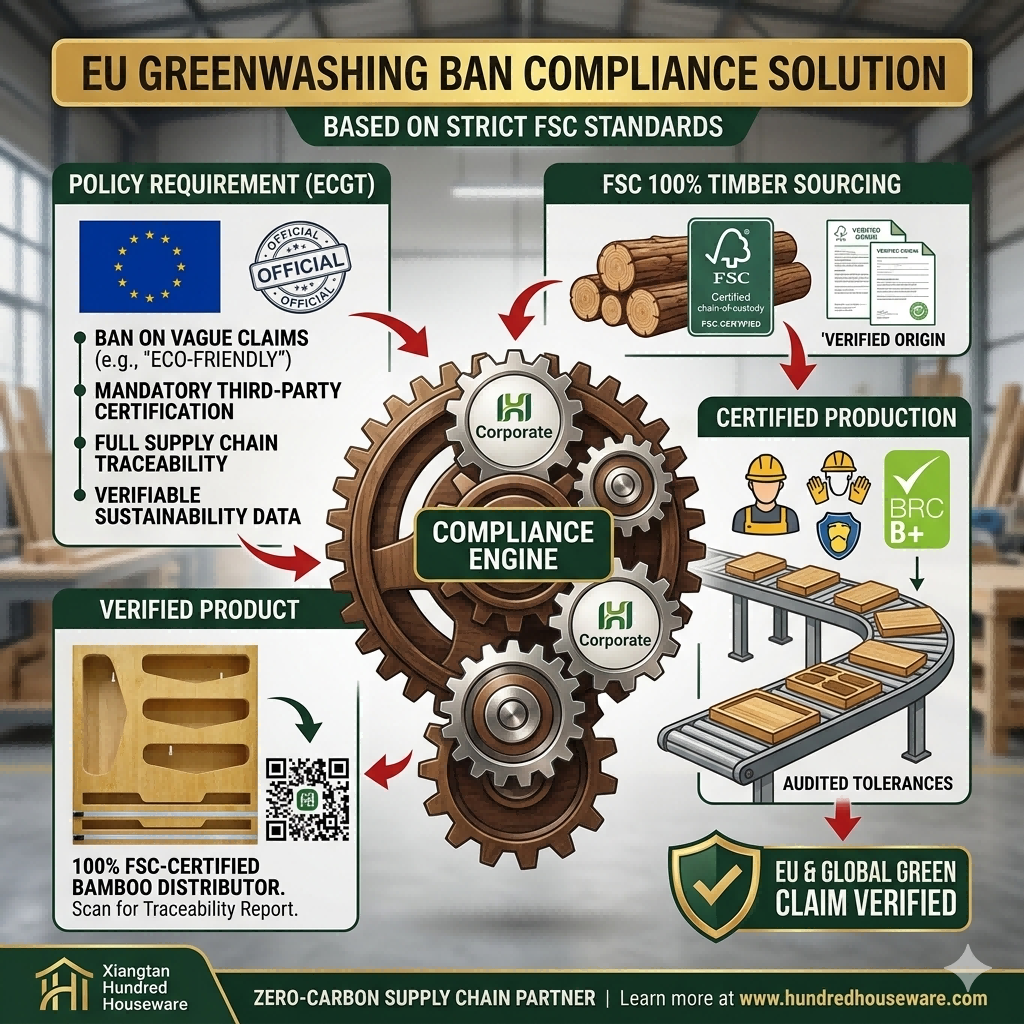
Working with agile, OEM/ODM manufacturers capable of low MOQ (500 pcs) production runs allows brands to test market demand without locking up capital in large, slow-moving inventory batches. Furthermore, manufacturers equipped with verified compliance frameworks (FSC certifications, EUDR compliance, and food-safe oiled finish standards) reduce regulatory hold times at EU and US customs entry points.
Conclusion: Building Resilience in an Uncertain World
Geopolitical developments in the Middle East underscore the reality that global trade in 2026 requires continuous adaptation. While macroeconomic factors remain outside individual company control, supply chain resilience is entirely manageable.
By restructuring inventory forecasting, optimizing container loading space, and partnering with experienced, compliance-ready manufacturers like Xiangtan Hundred Houseware, global B2B brands can successfully protect their margins and ensure consistent delivery to end consumers despite global disruptions.